
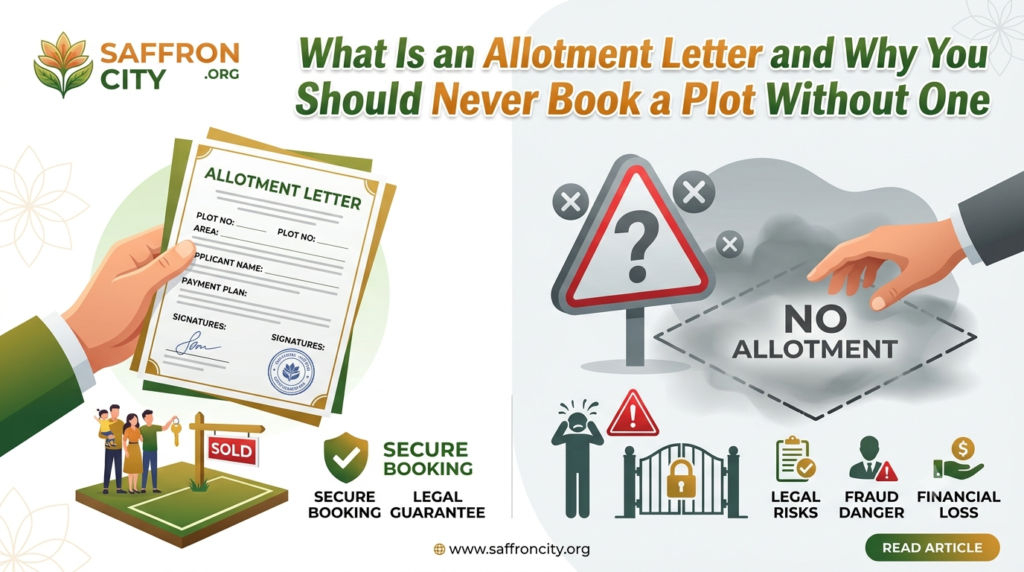
An allotment letter is the document a builder or developer hands you once you’ve paid your booking amount, confirming that a specific unit, not just “a flat somewhere in the project,” but that exact flat, on that floor, in that tower is now set aside for you. It’s not proof that you own the property. It’s proof that the property has your name on it, at least for now.
The term shows up in a few other places too, companies issue allotment letters when they allocate shares to IPO applicants, and government housing authorities issue them after a draw of lots. This article focuses on the version that matters most to home buyers: the property allotment letter, what it actually contains, how much legal weight it carries, and the mistakes people make when they treat it as more (or less) than it is.
What Is an Allotment Letter?
Strip away the legal language and it’s simple: an allotment letter is written confirmation from a developer, builder, housing authority, or housing society that a particular unit has been reserved in your name after you’ve made an initial payment.
It’s usually issued once you’ve paid somewhere between 10% and 20% of the property’s total value, though this isn’t a fixed legal number, just common practice across most builders. In government housing schemes, it often follows a draw of lots instead of a straightforward booking.
Here’s the part people get wrong most often: an allotment letter is not a title document. It doesn’t make you the legal owner. That only happens when the sale deed is registered. Think of the allotment letter as a strong “hold” on the property real, documented, and useful but not the finish line.
Allotment Letter vs. Booking Receipt
These two get confused constantly, so here’s the distinction. A booking receipt just confirms you paid money; it’s essentially a payment acknowledgment. An allotment letter format goes further: it ties that payment to a specific unit, with the floor, area, price breakdown, and payment schedule spelled out. If your builder only ever gives you a receipt and never follows up with an allotment letter, that’s worth asking about.
Provisional vs. Final Allotment Letter
Some builders issue a provisional allotment letter first, a placeholder with tentative details that might still shift as the project moves forward. Once the unit specifics are locked in, you get the final allotment letter, which is the version banks and lenders generally want to see. If you’re using an allotment letter to apply for a home loan and your lender pushes back, check whether you’ve actually got the final version or you’re still holding the provisional one.
What Details Does an Allotment Letter Contain?
A properly drafted allotment letter isn’t a vague paragraph; it should read almost like a contract summary. Here’s what to expect:
- Your details as the buyer (name, address, ID/PAN)
- The developer’s details, including their RERA registration number
- Project name, address, tower, and phase
- Unit number, floor, and configuration (2BHK, 3BHK, and so on)
- Carpet area and super built-up area, listed separately
- Total price and a full payment schedule
- Construction timeline and expected possession date
- Amenities promised clubhouse, parking, gym, whatever was part of the deal
- What happens if possession is delayed (penalty or compensation clause)
- Cancellation and refund terms
If any of these are missing, especially the payment schedule, RERA number, or cancellation terms, that’s a gap worth raising with the builder before you sign anything.
Why Is an Allotment Letter Important?
It’s easy to file this letter away and move on, but it does real work for you at several points in the buying process.
It’s your first documented proof that a specific unit is linked to your name, not just “interest” in the project, but that unit, reserved. Banks and NBFCs lean on this heavily: when you’re financing an under-construction property, the lender wants to see the agreed price and payment milestones in writing before they release funds, and the allotment letter is usually the document that gives them that. It also becomes the reference point for everything that follows the Builder-Buyer Agreement and, eventually, the sale deed both build on what’s stated here.
There’s a practical dispute-protection angle too. Say the brochure promised a clubhouse and a jogging track, and two years later the project delivers neither. If those amenities were listed in your allotment letter, you have something concrete to point to. Verbal promises from a sales team don’t hold up the same way.
And under RERA, once a unit is allotted, the developer generally can’t change its layout or specifications without your written consent. If they do say, they shrink the balcony or move a wall you’re entitled to object or seek compensation.
Is an RERA allotment letter Legally Binding?
It carries real legal weight, but with a boundary. Courts and consumer/RERA forums have accepted allotment letters as valid evidence of a transaction; they’re not just internal paperwork. But an allotment letter is not a substitute for a registered sale deed, and it doesn’t transfer ownership.
The RERA Act, 2016 gives buyers meaningful protection around advance payments and possession delays, and several RERA tribunals have, in practice, treated a valid allotment letter as sufficient grounds to pursue a refund claim when a project stalls. Exact provisions can differ by state, since each state RERA authority implements the central Act with its own rules so if you’re dealing with a live dispute, it’s worth checking your state RERA website or speaking with a RERA consultant rather than assuming national rules apply uniformly. (This article is for general understanding, not legal advice.)
Allotment Letter vs. Other Property Documents
Buyers often ask how the allotment letter fits into the bigger picture. Here’s the full sequence, since most comparisons online only cover the allotment letter against the sale deed and skip everything in between:
| Document | When Issued | What It Confirms | Legal Weight |
| Booking/Application Form | At initial inquiry | Buyer’s interest + token payment | Low informal |
| Provisional Allotment Letter | After booking amount | Tentative unit reservation | Low-medium |
| Final Allotment Letter | Once unit finalized | Specific unit, price, payment plan | Medium |
| Builder-Buyer Agreement / Agreement for Sale | After allotment | Detailed contractual terms, obligations of both parties | High |
| Possession Letter | At handover | Physical possession of completed unit | Medium-high |
| Sale Deed / Conveyance Deed | At registration | Legal transfer of ownership | Highest (registered document) |
How to Verify an Allotment Letter Is Genuine
Here’s a scenario that plays out more often than it should: a buyer books a flat in a “Phase 2” that, on paper, doesn’t actually exist yet no RERA registration, no sanctioned plan, just a sales pitch and a booking form dressed up to look official. The allotment letter looked legitimate. It had a letterhead, a signature, a unit number. What it didn’t have was a RERA allotment letter that matched anything on the state RERA website. By the time the buyer checked, the “phase” had been quietly delayed by two years with no formal disclosure.
That’s the real risk with allotment letters they’re easy to make look official even when the underlying project isn’t fully compliant. Before you treat one as solid ground, check a few things:
- Search the project’s RERA allotment letter on your state’s RERA website and confirm the project name, phase, and promoter details match exactly.
- Verify the unit number and area against the sanctioned building plan, not just the marketing brochure.
- Be cautious if the letter has no RERA number at all for a project that should be registered.
- Be cautious of a missing or vague payment schedule; legitimate allotment letters are specific, not general.
- Don’t sign under pressure. If a sales team is pushing you to sign immediately without giving you time to review, that’s a signal to slow down, not speed up.
- Keep both a digital and a physical copy once you do sign you’ll need it again for loan applications and eventually for the sale deed process.
What Happens If Something Goes Wrong?
No one plans for a project to stall or a builder to go back on what was promised but it happens, and knowing your options in advance beats scrambling for them later. Here’s what you can actually do if things don’t go the way your allotment letter said they would.
Can You Cancel an Allotment?
Yes, from either side, though the terms differ. If you cancel as the buyer, expecting the builder’s refund policy (and possibly state RERA rules) to apply some deduction from your paid amount is common, though the exact percentage should be spelled out in your allotment letter itself. If the builder wants to change something about your unit’s layout, the specifications RERA generally requires your written consent first. If they go ahead without it, you have grounds to object or claim compensation.
Filing a Complaint
If a project stalls, or the builder breaches what was promised in the allotment letter, the general process looks like this: gather your allotment letter, payment receipts, and any written correspondence with the builder, then file a complaint through your state’s RERA portal. Outcomes vary by case, but they typically range from a refund with interest to compensation for possession delays. This is a general outline, not legal advice for anything beyond a straightforward delay, talk to a RERA consultant or property lawyer who can look at your specific paperwork.
Tax & Stamp Duty Considerations
One thing that trips people up: an allotment letter is usually not a stamped or registered instrument by itself. Stamp duty typically applies when the sale deed gets registered, not at the allotment stage though this can vary by state, so it’s worth confirming locally rather than assuming.
For tax purposes, the allotment letter can serve as supporting documentation for instance, showing when you first committed to the purchase and at what price but it isn’t a substitute for registered proof of ownership when it comes to claiming property-related tax benefits. If you’re planning around this, a tax professional who knows your state’s rules will save you more guesswork than any general article can.
Allotment Letters Beyond Real Estate
Since the term isn’t exclusive to property, here’s a quick look at where else it shows up:
Share/IPO allotment letters confirm how many shares an applicant has been allocated after an IPO or rights issue if you’ve ever applied for an IPO and waited to see if you “got allotted,” this is the document behind that outcome.
Government housing scheme allotments are often issued after a draw of lots, since demand for these schemes usually outpaces available units.
Employer-provided accommodation allotment letters confirm which staff housing unit has been assigned to an employee.
If you’re here as a property buyer, though, everything above about verification, legal weight, and the document lifecycle is what actually matters for your situation.
Checklist: What to Verify Before Signing Your Allotment Letter
Before you sign, run through this:
- Unit number, floor, and configuration match what was promised
- Carpet area and super built-up area are both clearly stated
- Total price and payment schedule are itemized, not vague
- RERA allotment letter is present and checks out on the state portal
- Possession date and delay-penalty clause are specified
- Cancellation and refund terms are written down, not just verbally assured
- All promised amenities are listed in the letter itself
- You keep a signed copy digital and physical for your records
Conclusion
An allotment letter isn’t the finish line of buying a property, but it’s the first real, documented step the moment your booking amount turns into a specific unit with your name on it. Treat it the way you’d treat any contract you’re about to be bound by: read every line, check the RERA number against the actual portal, and don’t let anyone rush you past the parts about cancellation, delays, or unit specifications. Get that right, and the allotment letter does exactly what it’s supposed to, it protects you while you wait for the sale deed that actually makes the property yours.