

So you’ve found a plot you like. The location sounds right, the payment plan looks manageable, and the sales rep keeps saying “fully approved, no worries.” But here’s the thing almost every housing society master plan before buying a plot in Pakistan says that. The real question isn’t what the brochure says. It’s what the master plan actually proves, and whether you know how to check it yourself before you hand over your first installment.
This guide walks you through exactly that. No jargon for the sake of jargon, no vague reassurances just what to look for, what to ask, and what to avoid.
1. What a Master Plan Actually Tells You (And What It Doesn’t)
Most buyers hear “master plan,” “layout plan,” and “approved plan” and assume they’re all the same document. They’re not, and that confusion is exactly where a lot of buyers get burned.
- Master plan This is the big-picture vision. It shows how the society will be divided into sectors, where the green belts run, where the commercial area sits, and roughly how many Kanals go where. Think of it as the developer’s intention, drawn on paper.
- Layout plan This is the zoomed-in version. It breaks the master plan down into individual plots, street widths, and utility lines for a specific block or phase. This is the document that actually gets submitted for construction approval.
- Approved plan This is the layout plan after a development authority (RDA CDA LDA approval verification or a smaller body like PHATA) has reviewed it, stamped it, and issued an approval number against it.
The distinction matters because a developer can legally show you a beautiful master plan on their website while the actual approved layout plan vs master plan for the block you’re buying into still doesn’t exist. Both things can be true at once and only one of them protects you.
Why the Marketing PDF Isn’t the Same as the Approved Plan
Here’s a pattern worth knowing: a lot of society websites offer a “Download Master Plan” button. You click it, get a colorful PDF with green parks and wide boulevards, and feel reassured. But that PDF is a design document, not proof of approval. It doesn’t carry an approval number, a filing date, or a reference to the authority that signed off on it.
Real example: Picture two societies on the same stretch of GT Road, both marketing 5, 10, and 14 Marla plots with almost identical brochures. One of them lists an NOC number directly on its FAQ page and links to the authority’s verification portal. The other says “RDA NOC approved housing society” in bold on the homepage banner but never states a number anywhere on the site not on the FAQ, not in the payment plan, not in the master plan download. Same claim, completely different level of proof. Nine times out of ten, buyers only notice the difference after they’ve already paid the booking amount.
The fix is simple: before you get emotionally attached to a plot, ask for the exact approved layout plan number not the marketing master plan, the actual filed one and note which authority it was filed with.
2. How to Verify a Master Plan Is Actually Approved
Once you have a claimed NOC or approval number, verifying it takes maybe fifteen minutes. Skipping this step is how people end up locked into three-year installment plans for land that’s still “in process.”
Here’s the actual sequence:
- Get the NOC number from the developer directly. Not “RDA Approved” as a slogan the actual number, in writing, ideally on an official document or the developer’s own portal.
- Cross-check it on the relevant authority’s website. Every major development authority in Pakistan maintains some form of public NOC or society-verification list.
- Understand there are stages, not just a yes/no. A society can be at NOC stage, then Layout Plan (LOP) approval stage, then full development sanction these are different milestones, and marketing language often blurs them into one blanket “approved.”
- Confirm the mauza and khasra numbers. These are the land record identifiers tied to the actual plot of earth the society sits on. If a developer can’t or won’t give you these, that’s a conversation-ending red flag, not a minor omission.
| Authority | Region | What to Verify | Verification Method |
|---|---|---|---|
| RDA | Rawalpindi | NOC + Layout Plan | Official portal / office visit |
| CDA | Islamabad | NOC + Master Plan Compliance | CDA website / RTI-style request |
| LDA | Lahore | NOC + LOP | LDA portal |
| PHATA | Smaller Punjab societies | Registration status | PHATA portal |
What “Conditional NOC” vs “Full NOC” Actually Means
A conditional NOC means the authority has given tentative approval, but the developer still owes them something usually infrastructure guarantees, environmental clearance, or a performance bond. A full NOC means every box is checked and there’s nothing pending.
For someone paying in installments over three years, this distinction is not academic. A society sitting on a conditional NOC vs full NOC can stall mid-development if those pending conditions never get met, and you’ll have already paid a big chunk of the price by the time that becomes obvious.
Questions to Ask the Sales Office Directly
Keep this list on your phone when you visit:
- What is the exact NOC number, and which authority issued it?
- Is this a full NOC or a conditional one and if conditional, what’s still pending?
- Can I see the khasra mauza land records for the block I’m buying into?
- Is there a phase-wise development timeline I can see in writing?
- When exactly is the allotment letter issued relative to my payments?
A confident, legitimate developer answers all five without hesitation. A hesitant answer to even one is worth pausing over.
3. Red Flags in a Master Plan That Signal a File-Based or Unapproved Scheme

This is the part most guides skip entirely, and it’s the part that actually protects your money.
- No phase-wise development timeline. If the master plan just says “development in progress” with no dates, there’s no way to hold anyone accountable to a schedule.
- Amenities with no dedicated land parcel. A “Grand Mosque” or “Family Parks” mentioned in the text but not shown as an actual outlined plot on the plan itself is often just a promise, not a commitment.
- Kanal totals that don’t add up. If the society claims a certain total area but the sum of its listed sectors doesn’t come close, someone’s numbers are off and it’s rarely in your favor.
- No khasra/mauza numbers on request. This is one of the clearest tells. Legitimate developers share this without pushback.
- “Prelaunch” pricing before NOC confirmation. Prelaunch rates are attractive precisely because the risk is highest at that stage you’re often buying before the legal groundwork is finished.
- Large payments required before an allotment letter. Your booking amount should get you a formal allotment letter fairly quickly. If the developer wants two or three installments in before issuing one, that’s backwards.
The Difference Between “Development in Progress” and “Approved & Developing”
Construction photos on a website feel like proof of legitimacy bulldozers, graded roads, workers laying pipes. But development activity and legal approval are two separate things. A developer can be moving earth on a site while the NOC is still sitting in “under process” status with the authority. The photos aren’t lying to you, but they’re not answering the question you actually need answered.
4. What Happens to the Master Plan After You’ve Paid Legal Risks Buyers Overlook
Here’s something almost nobody tells first-time buyers: a master plan isn’t frozen in stone once you’ve booked your plot. Developers can and do file revisions narrowing a road, converting a planned green belt into additional commercial plots, or resizing a sector and if the authority approves the revision, it becomes the new official plan.
For a cash buyer, this is annoying. For an installment buyer three years into a payment plan, it can mean the amenity or view you bought into simply isn’t there anymore by the time you take possession.
- Your recourse usually runs through the authority’s public objection process most development authorities allow registered plot owners to formally object to a revision before it’s approved.
- Consumer protection and civil court options exist but are slow and costly, which is exactly why prevention matters more than remedy here.
How to Protect Yourself Contractually
- Get your plot’s location and dimensions tied explicitly to the approved layout plan reference not just a sector name like “Sector A, Plot near park.”
- Confirm the registry/transfer process in writing before you make your final installment, not after.
- Keep every payment receipt tied to a specific plot number, not a general “account.”
5. Master Plan Buyer Plot Investment Checklist Pakistan
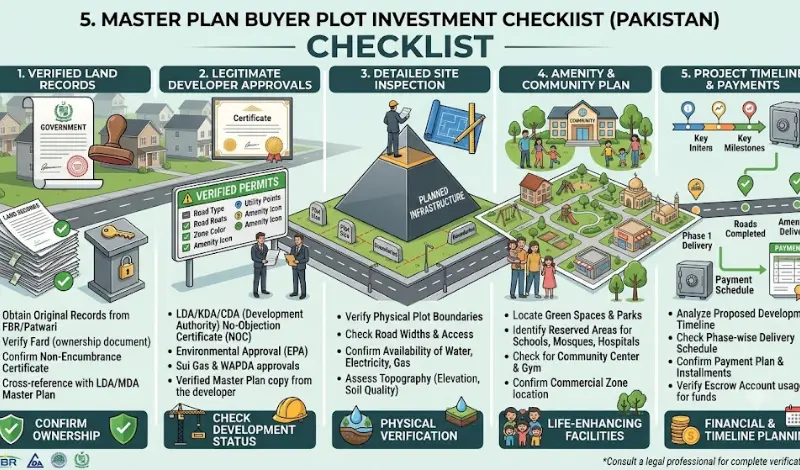
Save this. Go through it before you sign anything or pay anything beyond a token amount:
- NOC number obtained and independently verified with the authority
- Approved layout plan number matches the marketing master plan you were shown
- Khasra/mauza numbers cross-checked against land records
- Amenity land parcels (mosque, school, park) actually shown on the approved plan, not just described
- Phase-wise development timeline disclosed in writing
- Allotment letter process confirmed before major payments are due
- Developer’s track record on past projects checked independently
6. Good Master Plan vs. Weak Master Plan Side-by-Side
Everything covered so far comes down to a handful of signals you can check in one sitting. Lay them side by side and the difference between a society worth your money and one worth walking away from usually becomes obvious fast.
| Signal | Strong Master Plan | Weak/Risky Master Plan |
|---|---|---|
| NOC Status | Full NOC, number verifiable on authority portal | “Approved” claimed, no number given anywhere |
| Land Records | Khasra/mauza disclosed on request | Vague or refused |
| Amenities | Land parcels allocated on the plan itself | Only mentioned in marketing text |
| Timeline | Phase-wise dates published | “Ongoing” with no dates |
| Developer History | Verifiable, completed past projects | No prior delivered projects to check |
| Payment Trigger | Allotment letter issued before major payments | Large payments demanded before allotment |
7. Conclusion
A master plan can be the most reassuring document a developer shows you, or the thinnest piece of paper in the whole transaction the only way to tell the difference is to check it yourself instead of taking the brochure’s word for it. Get the NOC number, verify it with the actual authority, ask for the land records, and make sure your plot is tied to an approved reference rather than a sector name on a glossy PDF. None of this takes more than an afternoon, and it’s the cheapest insurance you’ll ever buy against a three-year installment plot buyer protection plan that goes nowhere. Do the checking before you commit, not after because once the payments start, your leverage to ask hard questions quietly disappears.