
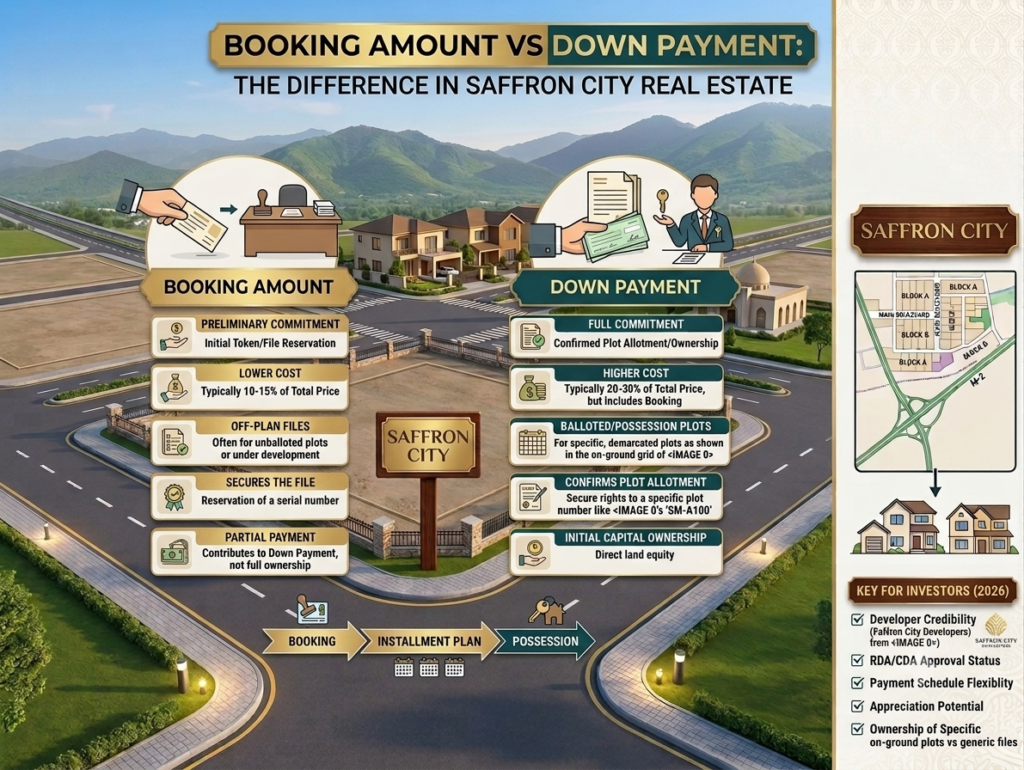
Here’s the short version before we go deep in Booking Amount vs Down Payment: a booking amount is a small, often flat sum you pay to reserve a property, vehicle, venue, or slot before any binding agreement exists. A down payment is a much larger, percentage-based payment you make after the agreement is signed, representing your actual stake in the purchase before a loan or financing kicks in.
Now let’s break down exactly how these differ, when each one is paid, whether you’ll get it back if things fall apart, and how much you should really be putting down at each stage whether you’re a first-time buyer, an agent explaining this to a client, or an investor trying to limit your exposure on a pre-launch deal.
What Is a Booking Amount?
Think of a booking amount as a placeholder, not a payment. It’s the money you hand over to say “I’m interested, don’t sell this to anyone else while I figure things out.” It doesn’t buy you the property or the car. It buys you time.
You’ll see booking amounts most often in:
- Real estate, especially pre-launch and under-construction projects
- Auto dealerships, particularly for high-demand models or specific trims
- Event venues and vendors, to lock in a date before a full contract is signed
- Coworking spaces, to hold a desk or cabin before onboarding
When Is a Booking Amount Paid?
It comes right at the start before due diligence, before you’ve seen the sale agreement, sometimes even before you’ve verified the seller’s credentials. That’s exactly why it needs to be treated with more caution than its small size suggests. People pay it too casually because the number looks harmless, and that’s when problems start.
Is a Booking Amount Refundable?
This is the question everyone actually searches for, and the honest answer is: it depends entirely on what the seller has written down, not on any universal rule.
- Most builders and dealerships don’t automatically refund a booking amount if you back out some deduct a “processing fee” and return the rest, some keep it all.
- If the seller cancels say, the builder scraps the project or the dealership can’t deliver the model you should get it back in full. Reputable sellers honor this; not all sellers are reputable.
- There’s no law that guarantees you get it back just because you changed your mind. This is different from a down payment, which usually has clearer contractual backing once an agreement exists.
The one thing you should always do before paying a booking amount: get the refund policy in writing, even if it’s just a line in an email. Don’t rely on a verbal promise from a sales executive.
What Is a Down Payment?
A down payment is the real financial commitment. It’s a substantial chunk of the total price, usually somewhere between 10% and 25%, that you pay yourself, out of your own funds, before a bank or lender finances the rest.
This isn’t a placeholder like the booking amount. It’s part of the actual purchase price. Pay more of it upfront, and you borrow less, which means smaller EMIs, less interest paid over the life of the loan, and in many cases, a better interest rate because lenders see you as lower risk.
You’ll encounter down payments in home loans, car loans, and larger B2B equipment or service contracts where a lender or vendor wants proof you’re financially serious before extending credit.
Typical Down Payment Percentages by Asset Type
Down payment amounts vary by asset here’s what to expect.
| Asset Type | Typical Down Payment | Notes |
| Resale home (mortgage) | 10–20% | Varies by lender, credit profile, and region |
| Off-plan / under-construction property | 5–20% (developer-set) | Often paid in tranches tied to construction stages, not one lump sum |
| Car loan | 10–20% | Can be lower depending on the financier and your credit score |
| Business equipment / service contract | 20–50% | Especially for custom, high-risk, or high-value orders |
Is a Down Payment Refundable?
Generally, no not once the sale agreement is signed. At that point, it’s not a security deposit sitting on the side; it’s already counted as part of the purchase price. Walk away after that, and you’re typically walking away from that money too, subject to whatever the agreement specifies.
This is worth distinguishing from a “deposit” in the legal sense, which in some jurisdictions must be returned doubled if the seller is the one who defaults. A down payment plain doesn’t usually carry that same protection; it’s simply your contribution toward the asset.
Booking Amount vs Down Payment: Side-by-Side Comparison
Now let’s put both terms side by side so the difference is impossible to miss.
| Factor | Booking Amount | Down Payment |
| Purpose | Reserve the unit, vehicle, or slot | Buyer’s actual equity contribution |
| Timing | Before any agreement or contract | At or after the agreement, before loan disbursement |
| Amount | Small, often a flat sum | Larger, percentage-based (typically 10–25%+) |
| Refundability | Depends on seller policy often partial or non-refundable | Usually non-refundable once the agreement is signed |
| Legal weight | Minimal an informal hold | Contractual legally part of the purchase price |
| Adjusted into final price? | Usually yes, credited toward the down payment | It already is the price contribution nothing further to adjust |
| Common industries | Real estate pre-launch, auto dealers, event venues | Mortgages, auto loans, high-value contracts |
The Full Payment Timeline From Booking to Possession
Knowing where each payment sits in the bigger sequence makes the whole thing far less confusing:
- Booking amount paid you reserve the unit, vehicle, or date
- Sale agreement signed the deal becomes legally binding
- Down payment paid your equity contribution is settled, adjusted against whatever booking amount you’ve already paid
- Loan sanctioned and disbursed the lender releases funds, either in full or in stages
- Remaining balance paid through EMIs, or through a construction-linked plan tied to build progress
- Possession and registration the asset is officially yours
The risky stretch is between steps 1 and 2. That’s when people commit money before they’ve verified the project’s legitimacy, checked registration details (like RERA status for Indian real estate), or read the fine print on refunds. Once you’re past step 2, you’re in a legally documented relationship before that, you’re mostly relying on trust and whatever’s in writing.
Booking Amount vs Down Payment by Industry
The split between the two looks a little different depending on what you’re buying.
Real Estate (Resale & Under-Construction)
For resale homes, the booking amount is usually a smaller, informal gesture, and the down payment follows shortly after at agreement signing. For under-construction properties, the down payment itself might not come as one lump sum; it’s often structured into a construction-linked plan (CLP), where you pay in tranches as the builder hits milestones like foundation, plinth, or flooring.
Vehicles
Car dealerships use booking amounts to hold a specific unit especially for high-demand models, limited colors, or variants on back-order. The down payment is the separate, larger sum paid at the time of actual purchase that reduces your loan amount.
Event Venues & Vendors
A booking amount locks in your date on the venue’s calendar. The remaining balance, sometimes still called a down payment, sometimes just “the balance” is typically due closer to the event and is often non-refundable within a certain window before the date.
Short-Term Rentals & Hospitality
Platforms and property managers in this space often use “advance payment” or “prepayment” instead of “booking amount,” but the underlying idea is the same: a portion paid upfront to secure the reservation, with tiered percentages that increase the closer you book to the check-in date.
How Much Should You Pay as a Booking Amount vs Down Payment?
If you’re a buyer: never hand over a booking amount larger than you’d be okay losing if the deal falls apart. Before you pay anything, get the refund policy in writing not a verbal assurance from whoever’s selling you the property or car.
If you’re an investor: on pre-launch or under-construction projects, negotiate a cap on the booking amount until you’ve completed due diligence checked the builder’s track record, project approvals, and land title. A booking amount that’s too high before you’ve verified anything just increases your downside if the project stalls.
If you’re an agent: set expectations early with your clients about what’s normal for your local market. Referencing the percentage table above helps clients understand they’re not being overcharged or helps them recognize when they are.
Red flag to watch for: any seller asking for a “booking amount” that’s functionally as large as a full down payment, without the contractual protections a real down payment agreement would give you. If it looks like a down payment in size but doesn’t come with a signed agreement, that’s a mismatch worth questioning.
Conclusion
The confusion between booking amount and down payment almost always comes down to one thing: not knowing where you are in the buying timeline. A booking amount is a small, early gesture that holds your spot. It carries little legal weight and its refund depends entirely on the seller’s policy. A down payment is the real financial commitment, made after you’ve signed an agreement, and it directly reduces what you’ll owe on a loan going forward.
Before you pay either one, know exactly which one you’re being asked for, get the refund terms in writing, and check whether your booking amount will be credited against your eventual down payment. That one question asked before you hand over any money would have saved Sarah from a very confusing afternoon at the agreement table.