
If you’re searching for how much down payment is required for a plot in Rawalpindi, chances are you’ve already run into conflicting numbers one office quotes 10%, another says 25%, and maybe a broker friend mentioned getting hit with extra “allocation charges” a week after booking that nearly doubled what he expected to pay upfront. The short answer: down payments on plots in Rawalpindi generally fall between 10% and 25% of the total price, depending on the society, its development stage, and how the payment plan is set up. But that single percentage rarely reflects the full amount you’ll actually need in hand before the plot is officially yours.
Down Payment Comparison Across Major Rawalpindi Societies
Before you commit to anything, it helps to see what other buyers are actually being asked for right now. Here’s how the down payment structures compare across the societies that come up most often when people search for plots in Rawalpindi.
| Housing Society | Down Payment / Booking | Remaining Payment Structure | Plot Sizes Available | NOC/Approval Status |
| Bahria Town Rawalpindi | ~20–25% | Quarterly/monthly installments over 2–3 years | 5 Marla – 1 Kanal+ | RDA/CDA approved (verify by phase) |
| DHA Rawalpindi/Islamabad | ~20–25% | Installments over 2–4 years, membership fee separate | 1 Kanal, 10 Marla | Approved |
| Capital Smart City | 10% + 10% confirmation | 42 monthly or 7 half-yearly installments | 5 Marla – 1 Kanal, farmhouses | RDA approved housing society (2019) |
| Park View City Rawalpindi | 25% | 30 monthly installments | 5, 7, 10 Marla, 1 Kanal | Pre-launch check current NOC status |
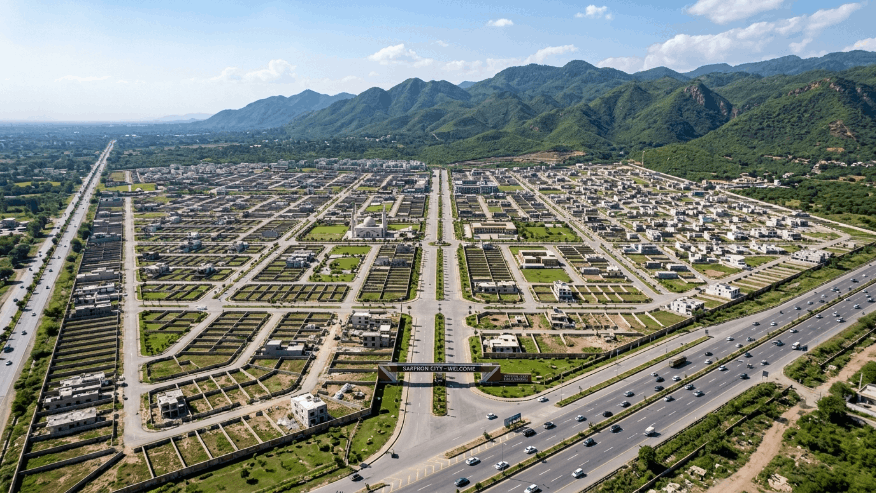
| Saffron City | 10% booking + 10% allocation | 30 monthly + 6 bi-annual installments, 5% on possession | 5, 7, 10, 14 Marla, 1 Kanal | RDA NOC approved |
Notice the pattern: the more established, fully-developed societies (Bahria Town, DHA) tend to ask for a bigger chunk upfront, while newer or pre-launch projects often lead with a smaller number to get buyers in the door faster. Neither is automatically “better” they just reflect different stages of the same business. Prices and terms shift often in this market, so treat this table as a starting point and confirm the current figures directly with the sales office before you commit to anything.
Why Down Payment Percentages Vary Between Societies
Down payment percentages aren’t random; they usually come down to four things: how far along the project is, how established the developer is, whether the NOC is actually approved, and where the plot sits within the society. Here’s how each one plays out.
Project Launch Stage (Prelaunch vs Post-Development)
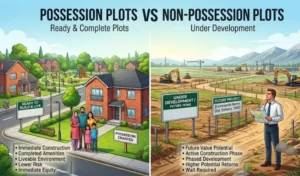
A society that’s still moving earth and laying roads has a different cash-flow problem than one that’s already balloted and handing over possession. Prelaunch projects often keep the down payment low, sometimes as little as 10% because they need buyers to commit early, before the infrastructure exists to prove the project is real. Fully developed societies can afford to ask for more upfront because the product is tangible: you can drive out, see the roads, see the plots, and know exactly what you’re buying.
Developer Track Record and Financial Position
A developer that’s already delivered two or three successful projects usually has steadier cash flow from ongoing sales and doesn’t need to squeeze every buyer for a large upfront sum. That’s part of why groups with a longer track record can sometimes offer smaller down payments and longer plot installment plan Rawalpindi windows; they’re not depending on any single project’s early sales to fund its own construction. A newer or smaller developer may genuinely need more capital upfront to get the ground moving. That alone isn’t a red flag it’s just something to weigh alongside the other signals in this guide.
NOC and Layout Plan Approval Status
Societies with a confirmed No Objection Certificate (NOC) and an approved Layout Plan (LOP) are operating on solid legal ground, and that legal certainty often lets them offer more buyer-friendly terms because they’re not competing purely on price to offset a buyer’s hesitation. Societies still waiting on approval sometimes compensate with a lower down payment, precisely because a cautious buyer needs an extra incentive to take the risk.
Plot Type and Position Within the Society
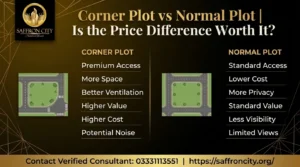
Two plots of the same size can carry different upfront costs depending on where they sit. Corner plots, park-facing plots, and plots on the main boulevard almost always carry an additional category charge on top of the standard plot down payment Rawalpindi percentage, a premium for a better location, not a change in the base plan. Commercial plots usually follow a similar percentage structure to residential ones, but because the total price is so much higher, the absolute rupee amount at booking is significantly bigger.
What’s Actually Included in “Down Payment” The Real Upfront Cost
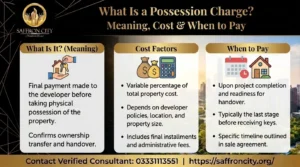
This is where most buyers get caught off guard, and it’s also the piece missing from almost every payment plan page out there. A society advertising “10% down payment” often means 10% booking plus a separate 10% allocation to charge two line items that individually look small but together mean you’re actually putting down 20% before your first monthly plot installment plan Rawalpindi even starts.
Here’s a real example using Saffron City’s published Sector A plan for a 5 Marla plot priced at roughly PKR 40,00,000:
- Booking (10%): PKR 4,00,000
- Allocation (10%): PKR 4,00,000
- Total cash needed before installments begin: PKR 8,00,000 double what the “10% down payment” headline suggests
- Then come 30 monthly installments of PKR 40,000, plus 6 bi-annual installments of PKR 2,00,000
- And separately, PKR 8,00,000 is due on possession
Add it up, and the plot ends up costing the buyer roughly PKR 40,00,000 in total which checks out but the point is that “10% down payment” is not the number that determines how much cash you need in hand on booking day. It’s the booking plus allocation together, and that’s before you’ve thought about possession charges or any category premium for a better-located plot.
Before you pay anything, ask the sales office for one specific figure: the total cash required at booking, all charges included. Not the percentage. Not the marketing headline. The actual rupee amount that leaves your account before the installment schedule kicks in.
How to Tell If a Down Payment Is a Red Flag, Not a Bargain
A low plot down payment Rawalpindi can be a genuine perk of buying early into a promising project. It can also be a way to pull in cash quickly before legal problems surface. The trick is knowing which one you’re looking at.
Watch for these signs before you pay anything:
- No verifiable NOC or Layout Plan listed on the official RDA or Punjab government portal sales brochures claiming approval mean nothing until you’ve checked independently
- Heavy urgency tactics “prices go up tomorrow,” “only 3 plots left in this block” designed to get you to pay before you’ve had time to verify anything
- No official receipt or allotment letter issued the same day you pay
- A sales team that won’t put payment terms in writing, or gets vague when you ask for the full schedule on paper
Before paying any down payment, verify the society’s NOC verification Rawalpindi status yourself through Punjab’s official portal at PTC Punjab rather than relying on what’s printed on a brochure or shown on a website banner. It takes a few minutes and it’s the single most useful check you can do.
Financing the Down Payment Options for Buyers and Overseas Pakistanis
Not everyone has PKR 8–15 lakh sitting around for a booking amount for plot Rawalpindi, and that’s fine there are a few common ways buyers cover it.
Several Pakistani banks offer plot financing Pakistan products that can help cover the down payment or bridge the installment schedule, though the rates and eligibility criteria change often enough that they’re worth confirming directly with the bank rather than trusting a third-party summary. Some buyers also look into government-backed housing finance schemes where available, again with terms best verified directly with the relevant bank.
For overseas Pakistani plot payment, the down payment itself carries an extra consideration: sending the money through proper banking channels not through informal hawala/hundi networks matters both for your legal protection as a buyer and so the funds are recognized as legitimate foreign remittance. It’s a bit more paperwork upfront, but it’s the difference between a documented, defensible transaction and one that’s hard to prove ever happened if a dispute comes up later.
Some developers also offer their own in-house “easy installment” plans as an alternative to going through a bank. These skip the bank paperwork entirely, which is convenient, but they also come with less regulatory protection than a bank-financed purchase worth factoring in if something goes wrong down the line.
What Happens If You Can’t Complete the Installments After the Down Payment
This is the question nobody wants to think about at booking time, but it’s exactly the moment you should be thinking about it because by the time it becomes relevant, you’ve already signed the paperwork.
Most societies include a forfeiture clause: miss enough installments, and you risk losing part or all of your down payment. Some developers are more flexible and allow you to resell or transfer an installment-only file to another buyer instead of losing the money outright but this varies enormously from one developer to the next, and it’s not something to assume. Read the cancellation and refund clause on your booking form or allotment letter plot booking before you sign it, not after a missed payment forces you to go looking for it.
The simplest way to avoid this entire problem: only commit to a down payment and installment default forfeiture clause schedule you’re comfortable sustaining for the full term, not just what feels manageable on the day you’re excited about the plot.
Documents and Safeguards to Get Before You Pay
Treat this as your minimum down payment housing society Rawalpindi checklist before any money changes hands:
- An official receipt for the down payment, issued in your name
- A signed booking form referencing your exact plot size, category, and agreed price
- An allotment or provisional booking letter confirming which plot has been allocated to you
- A copy of the society’s current NOC/LOP status verified independently, not just handed to you by the developer
- A written payment schedule showing every remaining installment default forfeiture clause amount and due date, not a verbal promise
- Copies of your own CNIC and your nominee’s CNIC, kept for your records
None of these take more than a few extra minutes to ask for, and every one of them is something you’ll wish you had if a dispute ever comes up.
Conclusion
There’s no single “correct” down payment for a plot in Rawalpindi; the honest answer is somewhere between 10% and 25%, depending on the society, its stage of development, and how established the developer is. What matters more than the headline percentage is understanding the full picture: what’s bundled into that number, what’s charged separately, whether the project’s legal approvals actually check out, and what your rights are if your circumstances change halfway through the installment plan.
A 10% down payment from a fully-approved, well-developed society can be a great deal. A 10% down payment from a project with no verifiable NOC verification Rawalpindi is a different story entirely. Do the five minutes of homework, check the NOC yourself, ask for the total cash figure in writing, read the cancellation clause before you pay anything, and you’ll be in a far stronger position than most buyers walking into a sales office for the first time.