
If you’ve ever budgeted for a plot purchase in Pakistan using just the sale price, you already know the surprise that comes next: the price tag on the file is never the number you actually pay. Stamp duty, registration fee, advance tax under Section 236K, society Transfer Fee and Registration Cost Calculator Pakistan, and membership fee usually push the real cost 5 to 12% above what the seller quoted, and this guide walks through every one of those costs between “we have a deal” and “the plot is legally yours” using real numbers, while also clearing up two things almost every buyer gets wrong: the difference between registry and transfer, and just how much your filer status actually changes what you pay.
1. Transfer Fee and Registration Cost Calculator
Before we get into the details, here’s the short version: use the calculator above to get an instant, itemized breakdown for your specific case. Enter your city or province, the property value (or DC/FBR rate if you know it), whether you’re buying or selling, your filer status, and if it’s a society plot the society name. The tool adds up the government side (stamp duty, registration fee, CVT where applicable, 236C or 236K) and the society side (transfer fee, membership fee, NDC charges) and gives you one total.
That combined total matters because most tools online only do half the job. A society transfer-fee calculator will tell you what DHA transfer fee calculator or Bahria charges but won’t touch your FBR tax. A government tax calculator will get your 236K number right but has no idea what your housing society charges on top of it. Neither one, on its own, tells you what you actually need in hand on registration day.
How to Use This Calculator
- Select your province or city rates differ across Punjab, Sindh, KPK, and Islamabad.
- Choose the property type: open plot, house, flat, or commercial.
- Enter the property value, or the DC rate/FBR valuation if the sale price is below it. Tax is always calculated on whichever figure is higher, not on what you privately agreed to pay.
- Select your filer status Filer, Non-Filer (the late-filer category was phased out under the latest Finance Act).
- If it’s a society plot, pick the society from the dropdown so the transfer and membership fee load automatically.
- Read the breakdown: government charges, society charges, and a grand total, split by buyer and seller.
Treat the output as a planning estimate. Rates get revised through Finance Acts and provincial notifications, so always confirm the exact figure with the sub-registrar’s office or the society’s transfer desk before you pay.
2. What Is Included in Transfer Fee and Registration Cost in Pakistan?
Here’s where most confusion starts: “transfer fee” and “registration cost” actually refer to two separate systems that happen to get paid around the same time. One is a government requirement that applies to every property in the country. The other only applies if you’re buying inside a private housing society. Knowing which is which stops you from either overpaying or missing a cost entirely.
Government Taxes & Fees (Apply to All Properties)
These apply whether you’re buying a plot from a housing society, a house on agricultural-turned-residential land, or a shop in an open market anywhere in Pakistan.
- Stamp duty is a provincial tax paid to make the sale deed legally enforceable, calculated on the DC rate or FBR valuation, whichever is higher.
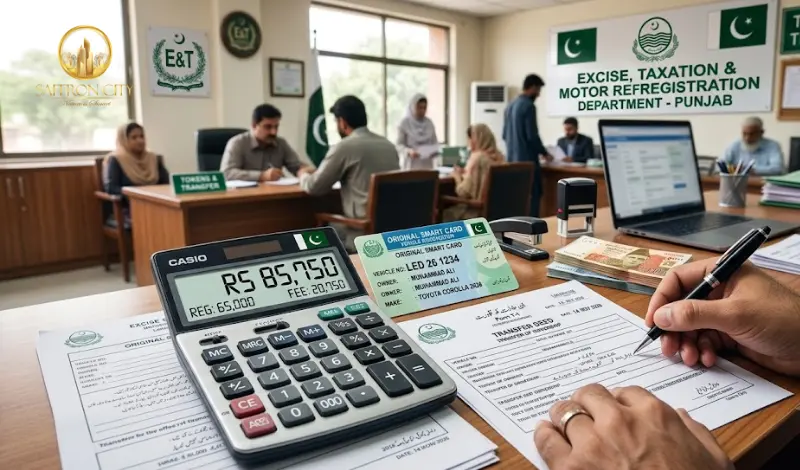
- Registration fee paid to the sub-registrar’s office to officially record the deed in government land records.
- Capital Value Tax (CVT) applies in select urban areas, typically calculated as a percentage of the declared value.
- Section 236K advance tax paid by the buyer at the time of transfer.
- Section 236C advance tax paid by the seller at the time of transfer.
- Map/Naqsha penalizes a Punjab-specific charge if the property’s map hasn’t been formally approved at the time of registration.
- TMA/Corporation fee a local body charge in some districts, usually a small percentage of value.
Housing Society Transfer Fees (DHA, Bahria, Gulberg, and Others)
If your plot is in a private housing scheme, there’s a second layer of cost that has nothing to do with FBR or the provincial government; it’s a private charge set by the society itself.
- Transfer fee usually calculated as a percentage of the DC rate, or a fixed rate per square foot for commercial units and constructed property.
- Membership fee is a one-time charge for first-time buyers becoming a society member.
- NDC (No Demand Certificate) charges confirm there are no outstanding dues on the plot before transfer can proceed.
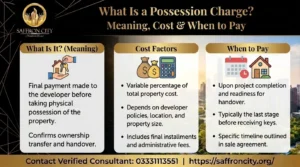
- Possession charges separate from transfer, this applies when the society formally hands over physical possession, often on newer or under-construction projects.
| Cost Type | Who Usually Pays | Applies To | Typical Basis |
| Stamp Duty | Buyer | All properties | % of DC/FBR value |
| Registration Fee | Buyer | All properties | Fixed or tiered fee |
| CVT | Buyer | Select urban areas | % of value |
| Section 236C | Seller | All properties | % of value, filer-status dependent |
| Section 236K | Buyer | All properties | % of value, filer-status dependent |
| Society Transfer Fee | Seller (by convention) | Society plots only | % of DC rate or per sq. ft. |
| Membership Fee | Buyer (first-time only) | Society plots only | Fixed amount |
3. Filer vs non-filer property tax: How Much Difference Does It Really Make?
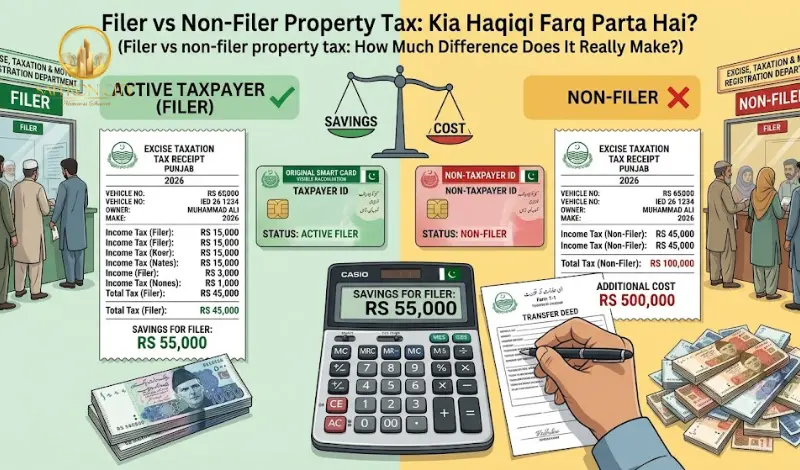
This is the single biggest lever in the entire transaction, and most buyers don’t realize how big it is until they’re standing at the registrar’s office. Under the current Finance Act, the late-filer category has been removed. You’re either an Active Taxpayer (filer) or you’re not. Filer rates are now flat, while non-filer rates still scale up with property value.
As things stand under the current rate card: a filer buyer pays 1.25% under Section 236K, flat, regardless of property value. A non-filer buyer pays a banded rate that climbs from roughly 10.5% up to 18.5% depending on the value slab. On the seller’s side, a filer pays 2.75% under Section 236C, while a non-filer pays around 11.5%.
Worked Example: A PKR 10,000,000 Plot in Punjab
Let’s put real numbers against a residential plot valued at PKR 1 crore (10,000,000), assuming both buyer and seller are on the Active Taxpayer List.
- Stamp duty (approx. 1% of value): PKR 100,000
- Registration fee (fixed/tiered, small districts): PKR 1,000–2,000
- CVT, where applicable (approx. 2%): PKR 200,000
- Section 236K, buyer, filer rate (1.25%): PKR 125,000
- Section 236C, seller, filer rate (2.75%): PKR 275,000
Buyer’s side alone comes to roughly PKR 426,000–427,000 on top of the purchase price before a single rupee of society transfer fee is added. Now swap the buyer to non-filer status at, say, the 14.5% band: the 236K component alone jumps to PKR 1,450,000. That’s over a million rupees of difference on the same plot, for the same price, just based on whether your name is on the ATL.
If you’re not currently a filer and you’re planning a purchase above a few million rupees, getting on the Active Taxpayer List before you sign anything is very likely the single highest-value thing you can do in this entire process.
4. Buyer vs. Seller: Who Pays What?
Property listings rarely spell this out, which is exactly why disputes happen mid-transaction. By convention not by law, so this is always negotiable between the two parties costs split roughly like this:
Buyer typically pays: stamp duty, registration fee, CVT (where applicable), Section 236K, and the membership fee if it’s their first plot in that society.
Seller typically pays: Section 236C, and in most societies, the transfer fee itself.
Total Cash Needed at Closing (Buyer)
Add up: property value + stamp duty + registration fee + CVT + 236K + membership fee (if applicable). This is the number that should be sitting in your account before you go to the registrar’s office, not the sale price alone.
Net Proceeds After Costs (Seller)
Take the sale price and subtract 236C and the society transfer fee. If you’ve also held the property in a way that triggers Capital Gains Tax, that comes off separately when you file your return it isn’t collected at the point of transfer the same way 236C is.
One honest note here: in practice, some of this gets negotiated. A motivated seller might absorb the plot transfer fee calculator Pakistan fee to close faster; a buyer in a competitive market might offer to cover 236C to sweeten the deal. Get whatever you agree on in writing in the sale agreement, because verbal splits tend to fall apart the day the bill actually arrives.
5. Registry vs. Transfer (Inteqal): What’s the Difference?
These two words get used interchangeably in everyday conversation, and that’s exactly where a lot of buyers get tripped up.
Registry is the legal act of executing and recording the sale deed at the sub-registrar’s office. It’s the step that makes the transaction legally binding, and it applies to essentially every property sale in Pakistan, in every province.
Inteqal (mutation) is the process of updating the revenue department’s ownership records so your name replaces the previous owner’s in the official land record. This matters most for older or non-computerized land, typically agricultural land or property outside a fully digitized society system. In many computerized housing societies, the “transfer” you do at the society office effectively serves this function internally, so you may not need a separate revenue-department mutation.
The practical takeaway: know which one (or both) your specific property needs before you assume the process and the cost is done after just one of them.
6. Province-Wise & City-Wise Cost Comparison
Pakistan doesn’t have one uniform rate card Punjab, Sindh, KPK, and Islamabad (ICT) each set their own stamp duty calculator Pakistan and registration structures, and provincial governments revise these periodically. Treat the numbers below as a general shape of how things differ, and confirm the exact current rate for your specific district before transacting.
| Province/Region | Stamp Duty (approx.) | Registration Fee | Notes |
| Punjab | Around 1% (rates revised periodically) | Fixed/tiered by district | Map/Naqsha penalty may apply if plan isn’t approved |
| Sindh | Varies by district | Fixed/tiered | CVT treatment differs from Punjab |
| KPK | Varies | Fixed/tiered | Generally lower urban density, fewer society-specific charges |
| Islamabad (ICT) | Set separately from Punjab | Fixed/tiered | CDA-administered sectors vs. RDA-administered zones can carry different rules |
It’s also worth not confusing this one-time plot transfer fee calculator Pakistan cost with the annual Urban Immovable property mutation Inteqal Tax (UIPT) a completely separate recurring tax based on Annual Rental Value, charged at roughly 5% in Punjab, 25% in Sindh (though on a much lower base value), and around 10% in KPK. That’s a yearly holding cost, not part of what you pay at the point of transfer.
7. Hidden & Informal Costs Buyers Often Forget
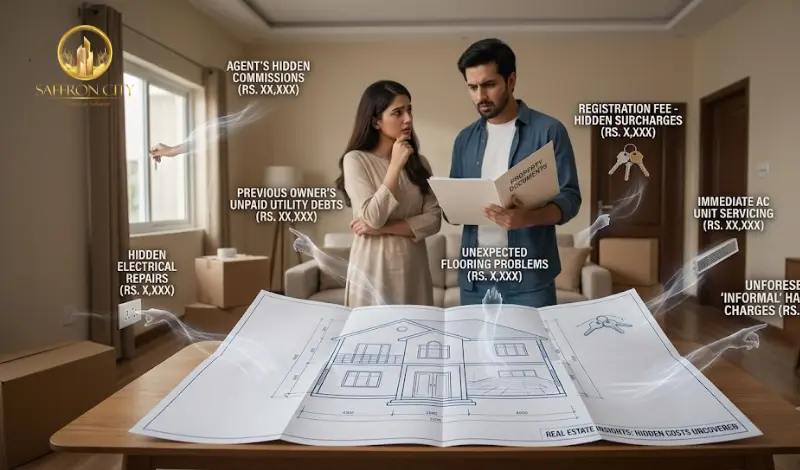
The line items above are what show up on an official receipt. These don’t, but they still come out of your pocket:
- Patwari/revenue office facilitation charges small, informal payments to move paperwork along, particularly for mutation on non-computerized land.
- Deed writer / vakalatnama fee someone still needs to draft the sale deed correctly; budget a few thousand rupees for this.
- NADRA verification charges biometric verification is now a standard step at registration.
- Real estate agent commonly commission around 1% of the sale value from each side, buyer and seller.
- Legal fee if you hire a lawyer to check the title and run due diligence, which is genuinely worth doing on any high-value purchase.
- Development or possession charges are relevant if you’re buying into an under-construction society block rather than an already-developed one.
None of these are optional extras you can skip your way around. They’re the difference between “the calculator said X” and “I actually needed X plus 3-4% more in hand.”
8. Step-by-Step property registration fee calculator Pakistan Process in Pakistan
- Token/bayana agreement: the buyer pays a token amount, followed by a bayana with a written agreement, to lock in the deal while documents are prepared.
- Document collection CNIC of both parties, prior title documents, non-encumbrance certificate, and NICOP for overseas buyers.
- Valuation checks confirm the FBR valuation and DC rate vs FBR value for the property, since tax is charged on whichever is higher than the private sale price.
- Payment of stamp duty is done through the e-stamping system rather than physical stamp paper in most provinces now.
- Deed drafting and signing at the sub-registrar’s office, in the presence of both parties (or their authorized attorney).
- Biometric verification through NADRA, as part of the registration process.
- Registration and mutation update the deed gets registered, and where applicable, the mutation is processed to update revenue records.
- Document collection once processed, you collect the registered sale deed and updated ownership record.
9. Special Considerations for Overseas Pakistanis (NICOP/POC Holders)
Overseas Pakistanis get a specific benefit worth knowing about: NICOP and POC holders can access filer-equivalent rates under Sections 236C 236K tax calculator even without being on Pakistan’s Active Taxpayer List, provided the transaction goes through documented banking channels typically a Roshan Digital Account or another recognized non-resident account. Paying in cash or through a regular local account removes this benefit and pushes you back to non-filer rates.
If you can’t be physically present, a Power of Attorney is the usual route it needs to be properly attested (often through the relevant Pakistani embassy or consulate abroad) and carries its own drafting and attestation cost, separate from the plot transfer fee calculator Pakistan fee itself. Keep NICOP or POC documentation ready from day one; missing it is one of the most common reasons overseas transactions get delayed.
Conclusion
The plot price you agree on with a seller is only the starting point. By the time stamp duty, registration fee, CVT, and advance tax under 236C 236K tax calculator are added plus a society’s own transfer and membership fees if it’s a private scheme your real closing cost can run well above what the initial figure suggested. The single biggest factor in that final number isn’t the province you’re buying in or even the society; it’s whether you’re a filer. Getting that status sorted before you sign anything, checking whether your property needs registry, mutation, or both, and running your numbers through a calculator before you commit token money are the three things that will save you the most money and the most stress. Use the calculator above with your actual numbers, and confirm the final figures with the sub-registrar or society office before you pay.