
If you have ever sat across a sales agent’s desk with a master plan spread out in front of you, you already know the moment. The agent taps a plot at the intersection of two roads and says, “Sir, this is a corner plot, it carries a bit of a premium, but it’s the best option for investment.” Then he taps another plot two rows down and says the opposite: “This is a regular plot, it’s cheaper and much more peaceful too.”
Both statements can be true at the same time. That is exactly why the corner plot vs normal plot decision confuses so many buyers.
This guide breaks down the real difference between a corner plot and a normal plot, not just in terms of pros and cons, but in terms of price mechanics, legal paperwork, and what actually happens to your money once you sign the payment plan. Whether you are a first-time buyer, a real estate agent advising a client, or an investor comparing options in a 5 Marla, 10 Marla, 14 Marla, or 1 Kanal block, this article is built to answer the question properly.
1. What Is a Corner Plot?
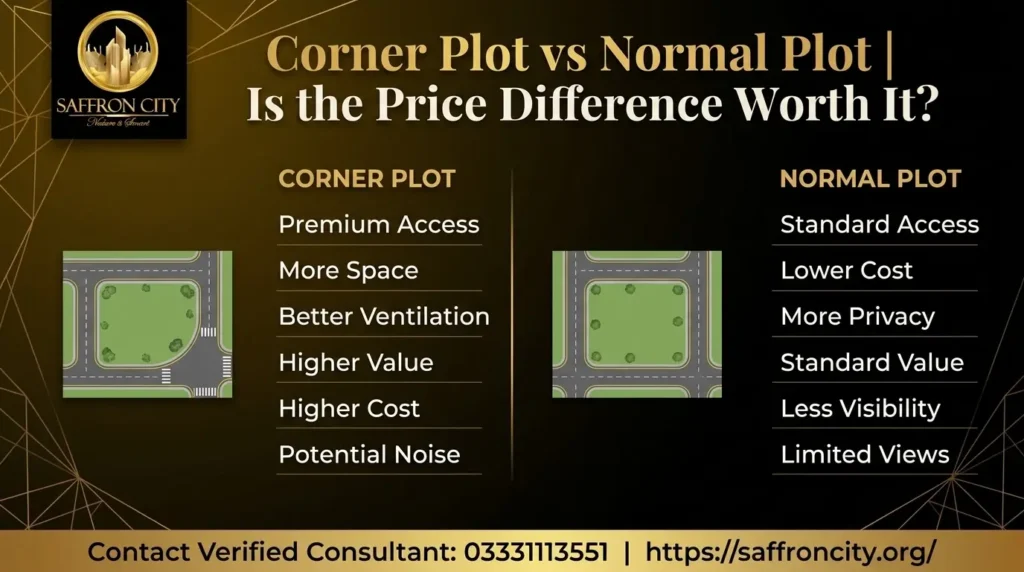
A corner plot sits at the intersection of two streets. Instead of having one side facing a road and three sides bordered by neighbors, a corner plot has two open sides. This single structural fact is the reason almost every other difference on this list exists, from ventilation to price to privacy.
In most housing societies, corner plot resale value are not randomly scattered. Developers plan them deliberately at block intersections during the layout stage, and they are usually marked clearly on the master plan with a distinct boundary shape (an L-shaped or wider frontage compared to neighboring plots).
How Corner Plots Are Marked in a Master Plan
If you are looking at a society’s layout for the first time, corner plots are usually the easiest to spot. They sit at the point where two internal roads meet, and their plot number often appears at the edge of a block rather than in the middle of a row. Before you agree to pay any premium, always ask to see this on the actual master plan document, not just a verbal description from a sales agent.
2. What Is a Normal (Regular) Plot?
A normal plot, also called a regular or mid-row plot, sits between two other plots in the same row. Only one side faces the street directly. The remaining sides are shared boundaries with neighboring houses.
This is the most common plot type in any housing society, simply because a block of land naturally produces far more mid-row plots than corner ones. It is also the default option most buyers end up with, not because it is inferior, but because it is what is actually available in the largest quantity.
Two related categories worth knowing, since they often come up in the same conversation: park-facing plots (which front a green belt or park) and boulevard plots (which front a wide main road). Both carry their own pricing logic, which we will touch on briefly later.
3. Corner Plot vs Normal Plot: Full Comparison Table
Here is the quick version, if you want the answer before the explanation.
| Factor | Corner Plot | Normal Plot |
|---|---|---|
| Price premium | Typically 10 to 30% higher | Baseline price |
| Ventilation and light | Better, two open sides | Limited, one side open |
| Privacy | Lower, visible from two streets | Higher |
| Design flexibility | More options, dual entrances possible | Limited to one facade |
| Parking space | Extra space along the side street | Usually one dedicated spot |
| Noise and traffic | Higher, especially near main roads | Lower |
| Maintenance cost | Higher, more boundary wall and lawn | Lower |
| Resale value | Generally higher and quicker to sell | Moderate |
| Commercial potential | Strong, suited for shops or offices | Limited |
| Best suited for | Investors, commercial buyers, design-focused families | Families wanting privacy and quiet, budget-conscious buyers |
4. Advantages of Corner Plots

Before getting into the tradeoffs, it’s worth understanding why corner plots command a premium in the first place. Most of it comes down to one simple fact: two open sides instead of one changes almost everything about how a home lives, looks, and eventually sells.
Better Ventilation and Natural Light
Because two sides of the plot are open to the street instead of one, air moves through the house far more easily, and sunlight reaches more rooms during the day. This is not just a comfort issue. which plot is better to buy cross ventilation reduces indoor humidity, cuts down on mould in bathrooms and kitchens, and can lower your electricity bill since you rely less on artificial lighting and cooling during the day.
More Design and Construction Flexibility
A corner plot gives an architect more to work with. Dual street access means you can plan a separate entrance for guests and a service entrance for staff or deliveries, something that is almost impossible on a mid-row plot. Wider frontage also allows for bigger windows, wraparound balconies, and more creative elevation designs that would look out of place squeezed between two other houses.
Higher Resale Value and Investment Liquidity
This is where corner plot investment logic gets interesting. It is not just that corner plots sell for more. It is that they usually sell faster. In a housing society where inventory sits for months, a corner plot with good visibility tends to attract a buyer more quickly, because both end-users and investors want it. For anyone thinking about resale value as much as living comfort, that speed matters as much as the price tag.
Extra Parking and Commercial Potential
Because a corner plot faces two roads, homeowners often get informal extra parking space along the side street, something mid-row homes simply cannot offer. This also makes corner plots attractive for future commercial conversion (a small clinic, an office, a retail unit) in societies where mixed-use is permitted, since visibility from two directions is valuable for any kind of walk-in business.
5. Disadvantages of Corner Plots
A corner plot’s biggest strengths and its biggest drawbacks come from the exact same source: dual street exposure. The same openness that brings in light and design freedom also brings in cost, noise, and a few privacy tradeoffs worth planning for before you commit.
Higher Purchase Price
The often-quoted corner plot price premium of 10 to 30% is real, but it is rarely a fixed industry number. It depends on the developer, the block, and even how many corner plots are left unsold in that particular phase. This premium is the single biggest deciding factor for most buyers, and we will look at exactly how it gets applied in payment plans further down.
Less Privacy and More Noise
A corner plot is visible from two streets instead of one, which means more passersby, more headlights at night, and generally less of the closed-off feeling that mid-row homes offer. Traffic noise is also more noticeable at intersections than mid-block. Most owners deal with this through taller boundary walls, frosted glass on street-facing windows, or landscaping that blocks the direct line of sight from the road.
Higher Maintenance Cost
More exposed wall means more paint, more repairs, and more general upkeep over the years. If the plot includes two lawns instead of one, that is also double the gardening and irrigation work. None of this is a dealbreaker, but it is an ongoing cost that mid-row owners simply do not have.
Advantages of Normal Plots
- More affordable entry point, which matters most for first-time buyers working with a fixed budget
- Greater privacy, since neighbors on either side naturally limit visibility into the property
- Quieter surroundings, with less traffic and dust compared to plots sitting at a road junction
- Lower long-term maintenance cost, with only one street-facing wall and typically one lawn to manage
Disadvantages of Normal Plots
- Limited ventilation and natural light, since neighboring walls sit on three sides
- Restricted design options, since only one facade actually faces the street
- Lower visibility, which can matter later if you ever want to rent the property out or convert it for a small business
6. How Corner Plot Pricing Actually Works in Payment Plans
This is the part most buyers never ask about until they are already midway through a booking, and it is where a lot of confusion (and disappointment) comes from.
In societies that sell on installments rather than lump-sum cash, the corner plot premium is not always charged as one clean number. Depending on the developer, it typically shows up in one of three ways:
- Added at booking. The 10% booking amount is calculated on the higher, premium-inclusive price from day one.
- Added at allocation. The base price is booked normally, and the corner premium is added separately once the specific plot is allocated to you.
- Spread across installments. The premium is divided proportionally across the monthly and bi-annual installments, so it never appears as one lump sum, but quietly raises every payment slightly.
Here is a simple example to make this concrete. Say a 10 Marla normal plot in a society is priced at PKR 75,00,000, split across a 10% booking, 10% allocation, 30 monthly installments, 6 bi-annual installments, and a possession payment. If the same block’s corner plot carries a 15% premium, that plot is not 75,00,000 anymore, it is roughly 86,25,000. If that premium gets added at the allocation stage, your allocation payment alone jumps from 7,50,000 to close to 18,75,000, even though your monthly installment plan might look almost identical on paper at first glance. Buyers who do not ask this question upfront are often surprised months later when the allocation letter arrives with a bigger number than expected.
Questions to Ask Before Paying a Corner Plot Premium
- Is the premium a fixed rupee amount or a percentage of the total price?
- Is it paid upfront, at allocation, or spread across the installment plan?
- Is the premium clearly written into the official payment plan document, not just quoted verbally?
- Does the same premium percentage apply to both residential and commercial blocks, or does it differ?
Ask for these answers in writing before you commit. A verbal quote from a sales agent is not the same thing as a number printed on your booking form.
7. Legal and Documentation Considerations for Corner Plots
Corner plots often come with slightly different construction requirements under local development authority bylaws, particularly around boundary wall setbacks near the road junction. These rules exist to keep sightlines clear for traffic safety, and they can affect how much usable covered area you actually get compared to what the plot size suggests on paper.
Before paying any premium, confirm two things directly from the documents, not from conversation:
- That the plot is officially marked as a corner plot on the approved site plan and allotment letter, not just described that way by the sales team
- That the society’s NOC and layout approval from the relevant development authority actually covers the block your plot sits in
This matters even more for overseas buyers who cannot visit the site in person. In that situation, cross-checking the master plan document and the NOC status online, along with asking for a location pin or geo-tagged photo of the specific plot, is the safest way to confirm what you are actually paying for before wiring any money.
8. Corner Plot vs Park Facing vs Boulevard Plot
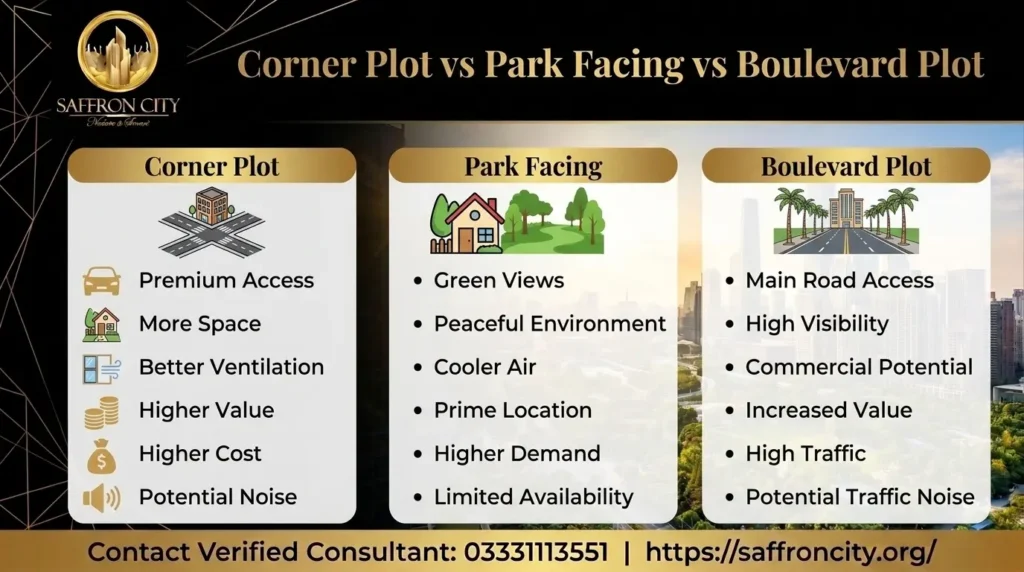
Since these three categories often get mentioned in the same sales pitch, here is the short version of how they differ.
Park-facing plots sit directly opposite a green belt or park. They carry a moderate premium and are best suited for families who value a lifestyle upgrade and long-term, stable living rather than fast resale. Boulevard plots front a wide main road and usually carry the highest premium of the three, but they also offer the strongest commercial potential thanks to visibility and footfall. Corner plots sit in between the two, offering a genuine balance of investment upside and everyday livability, which is exactly why they remain the most commonly discussed comparison of the three.
9. Which One Should You Buy? A Decision Framework
By now the pros, cons, and pricing mechanics are on the table. What’s left is matching them to your actual situation, since the “right” plot has less to do with which one is objectively better and more to do with what you’re trying to achieve.
Choose a Corner Plot If
- You plan to build a larger or custom-designed home and want more architectural freedom
- Resale value and faster liquidity matter more to you than upfront savings
- You are keeping future commercial use on the table, even if it is not the plan right now
- Your budget has enough flexibility to absorb a 10 to 30% premium without straining your installment plan
Choose a Normal Plot If
- You are a first-time buyer working with a tighter, fixed budget
- Privacy and a quiet street matter more to you than design flexibility
- You want predictable, lower maintenance costs over the years
- You have no plans to sell quickly or convert the property for business use
Advice for Real Estate Agents Advising Clients
The conversation should change depending on who is sitting across from you. An end-user buying a home to live in for the next twenty years cares about privacy, noise, and family comfort. An investor cares about resale speed, liquidity, and the actual premium math on the payment plan.
Before recommending either option, walk the client through a short checklist: confirm their budget ceiling including the premium, ask directly whether they intend to build immediately or hold as an investment, and always get the corner plot premium terms in writing before they sign anything. A good agent’s job here is less about pushing the “better” plot and more about matching the plot type to what the client is actually trying to achieve.
Conclusion
There is no universal winner between a corner plot and a normal plot. There is only the option that actually fits what you are trying to do. If design flexibility, resale speed, and future commercial potential matter most to you, and your budget can comfortably absorb the premium, a corner plot is usually worth the extra cost. If privacy, quiet living, and a tighter budget matter more, a normal plot gives you nearly all the same lifestyle without the added expense and upkeep.
The one thing every buyer, agent, and investor should do the same way: get the actual premium, payment schedule, and legal status in writing before committing to either one. That single habit prevents almost every regret people have after signing.