
A possession charge is a payment you make to a developer when your property handover process not a legal term, despite what Google’s search results (mostly about drug possession charges in real estate) might suggest. It’s separate from your installments, it’s not optional, and it’s often one of the biggest single payments in the entire buying process, so knowing it’s coming matters. This article covers what it includes, when it’s due, how much to expect, and how to check the number you’re asked for actually matches your original agreement.
1. What Is a Possession Charge?
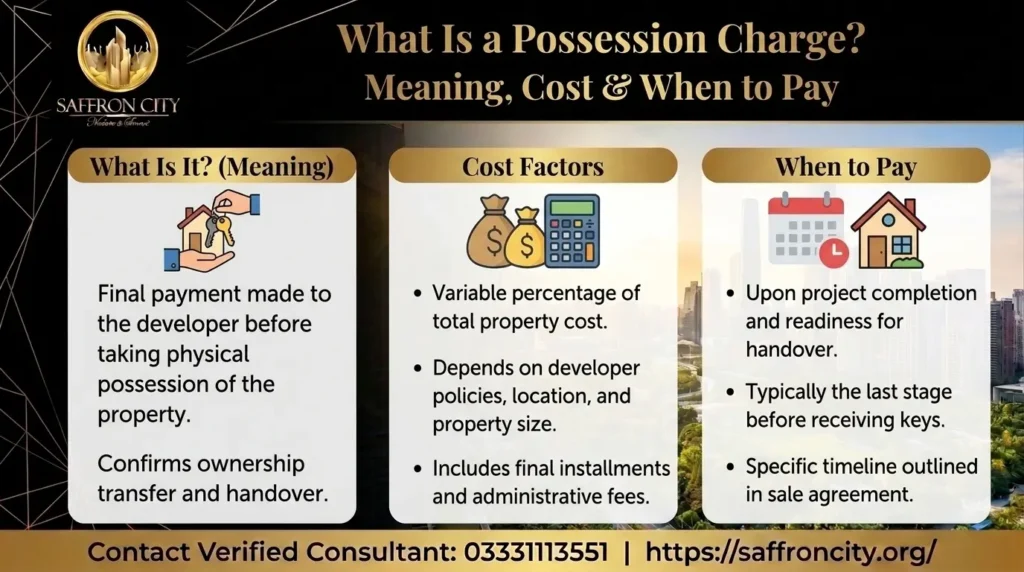
A possession charge is the payment a developer collects when a plot, house, or commercial unit is ready to be handed over to the buyer. It’s separate from the base price of the property and separate from your regular installments. Think of it as the final cost of finishing the job the developer has been building roads, laying utility lines, and completing the infrastructure around your unit for months or years, and a chunk of that cost gets billed right at the end, when the work is actually done.
This is why the charge exists at all: developers don’t finish every part of a project on day one. Roads, water connections, electricity, sewerage a lot of that gets completed closer to handover charges real estate, not at booking. Billing part of the cost at possession lets the developer match the payment to the actual construction timeline instead of asking you to pay for infrastructure that doesn’t exist yet.
Why Developers Charge It
Development doesn’t happen all at once it happens in phases, and possession-stage work (final utility hookups, road completion, landscaping, sometimes boundary walls) tends to land near the end. Charging for it at handover also helps developers manage cash flow across a project that might run three to five years from launch to completion, rather than trying to front-load every cost into the initial booking amount.
Who Actually Pays It
This applies whether you bought a residential plot, a house, or a commercial unit and it applies whether you’re a first-time buyer or an investor. If you’re buying to live in the property, you’ll pay it directly. If you’re an investor planning to resell before physical handover, the possession charge doesn’t disappear it just becomes something you and the buyer need to sort out contractually, usually by agreeing on who covers it.
2. Possession Charge vs. Other Property Payments
One of the most common sources of confusion is that possession charges get lumped in with four or five other fees that sound similar but aren’t. Here’s how they actually break down:
| Charge Type | What It Covers | When It’s Paid |
|---|---|---|
| Booking Amount | Reserves your plot or unit | At booking (typically ~10%) |
| Allocation Charge | Confirms your specific block, unit, or location | Shortly after booking |
| Installments | The base price, paid over time | Monthly or bi-annually |
| Development Charges | Roads, utilities, general infrastructure | Spread across the installment period |
| Possession Charge | Final handover costs and utility connections | At or near physical/legal handover |
| Transfer Fee | Moving ownership records to a new buyer’s name | At resale/transfer |
| Maintenance Charges | Upkeep of shared spaces and common areas | Ongoing, after possession |
Notice that possession charges sit at a specific point in this timeline the very end. Everything before it is about buying the property; the possession charge is about actually taking it.
3. When Do You Have to Pay a Possession Charge?
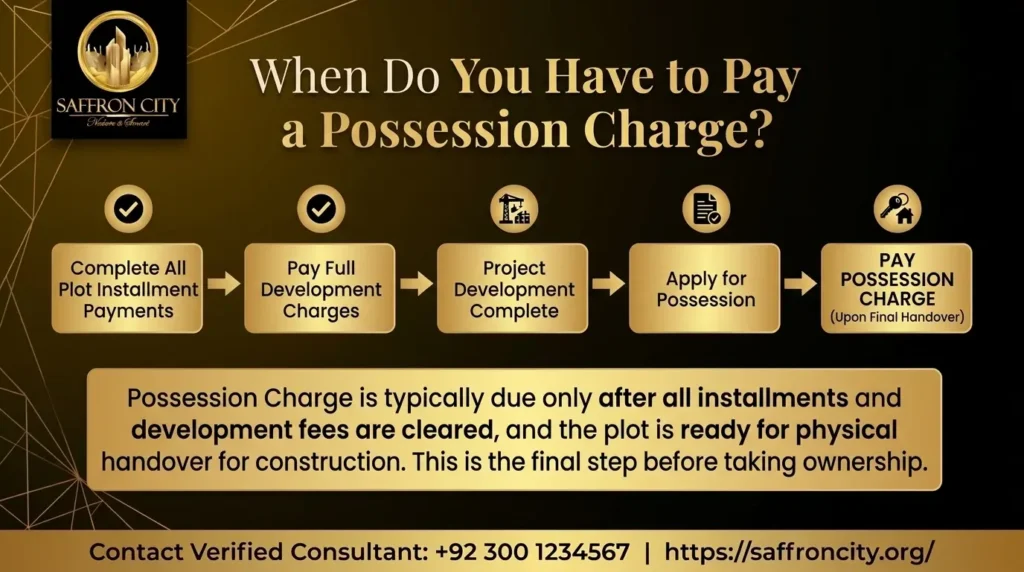
The trigger isn’t “whenever you feel ready to move in.” It’s tied to a specific event: the developer issuing a possession letter, sometimes called a possession notice. Once that letter goes out, the possession charge is typically due either right before it’s issued or immediately after the exact sequence depends on the developer’s own payment plan, so it’s worth checking your specific agreement rather than assuming.
It also helps to know there are two kinds of possession: physical possession, where you actually get the keys or the site handed over, and legal possession, which is more about documentation and can happen even if some infrastructure work is still in progress. Developers sometimes issue legal possession first and physical possession later, and the possession charge is usually tied to whichever milestone your specific agreement defines.
What Typically Triggers the Demand
- Major infrastructure milestones being completed roads, the utility grid, sewerage lines
- The relevant development authority finalizing approvals or NOC status for that phase
- All prior installments being fully paid off
If any of these are still pending, you generally shouldn’t be asked for a possession charge yet and if you are, that’s worth questioning.
What Happens If You Delay Payment
Most payment plans include late fees or surcharges if you miss the possession charge deadline, similar to how late installments are handled. In more serious cases, delaying too long can push back when your possession letter is actually issued, since developers typically won’t finalize handover until the payment clears. Always check the default and penalty clauses in your allotment agreement before you sign that’s where this gets spelled out, not in the marketing brochure.
4. How Much Are Possession Charges, Really?
There’s no single fixed number here, but a common range across housing schemes is roughly 10-20% of the total unit price. The exact figure depends on the developer, the city, the type of property, and how far along the project is.
Here’s a real example to make this concrete. Saffron City, a residential development on GT Road near Rawat, publishes its payment plan with possession charges built right into the schedule:
| Plot Size | Total Price (PKR) | Booking (10%) | On Possession | Possession Charge as % of Total |
|---|---|---|---|---|
| 5 Marla | 40,00,000 | 4,00,000 | 8,00,000 | 20% |
| 10 Marla | 75,00,000 | 7,50,000 | 15,00,000 | 20% |
| 1 Kanal | 1,40,00,000 | 14,00,000 | 28,00,000 | 20% |
Notice the pattern: across every plot size, the possession charge lands at exactly 20% of the total price on top of the 10% booking payment, monthly installments, and bi-annual payments already made. For a 1 Kanal plot at 1.4 crore, that means the buyer needs to have 28 lac ready specifically for the handover stage, separate from everything paid before it. That’s the kind of number you want to know well in advance, not discover a month before your possession letter arrives.
Factors That Move the Number
- Plot or unit size larger units carry a bigger possession charge in absolute terms, even if the percentage stays the same
- Location within the project corner plots or units facing a main boulevard often carry a premium here too
- Project stage at handover earlier phases sometimes differ from later phases in the same development
- Residential vs. commercial classification commercial units often carry different terms than residential ones
5. Possession Plots vs. Non-Possession Plots
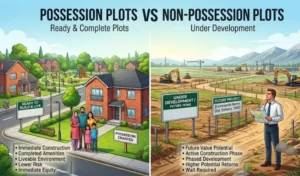
Not every plot you can buy today is ready for possession and that distinction matters for this whole conversation. A possession plot is one that’s ready to be physically handed over: infrastructure is in place, and you can actually access and use it. A non-possession plot is still under development you own it on paper (a “file”), but there’s no physical handover yet, and no possession charge is due until that changes.
Risks of Buying Non-Possession Plots
- You can’t use the property yet, no matter how much you’ve paid
- You’re depending heavily on the developer’s timeline and track record
- Resale value can swing more, since buyers are essentially trading on a promise rather than a finished product
If you’re weighing this trade-off in more depth, our earlier piece on possession plots vs non-possession plots breaks down exactly how to evaluate that risk before you commit.
6. How to Make Sure a Possession Charge Is Legitimate

Before you pay anything at the possession stage, cross-check the amount against your original allotment letter and payment schedule. A legitimate possession charge should match what you agreed to at booking it shouldn’t be a number that suddenly appears with no paper trail behind it.
It’s also worth confirming the project’s NOC status directly with the relevant development authority before handing over a large sum at this stage not because possession charges are inherently suspicious, but because this is the single largest payment in the process, and it’s the moment where verification matters most.
Red Flags Worth Watching For
- A possession charge demanded without a formal possession letter or NOC verification
- An amount that doesn’t match your original payment plan
- Pressure to pay quickly, in cash, with no receipt or written confirmation
None of this means most developers are acting in bad faith it just means this is the stage where a five-minute check saves you a much bigger headache later.
7. Possession Charges: Investor vs. End-User Perspective
If You’re Investing
If you’re planning to resell before possession, get clear in writing on who covers the possession charge: you or the buyer. It’s an easy detail to overlook mid-negotiation, and it directly affects your actual return. When you’re running the numbers on ROI, the possession charge belongs in that calculation just as much as the base price does.
If You’re Buying to Live In It
Budget for the possession charge as its own line item, separate from your monthly installment payment plan. It’s often the largest lump-sum payment in the entire process, so it deserves its own place in your financial planning not an assumption that “the final installment” is the last big payment you’ll make.
Conclusion
A possession charge is simply the price of getting your property actually handed over not a penalty, not a hidden fee, just the final stage of a payment plan you agreed to when you booked. The developers that handle this well will have it clearly laid out in your payment schedule from day one, tied to a specific milestone (the possession letter), and consistent with what you signed up for. Your job as a buyer is straightforward: know the number in advance, know what triggers it, and confirm it against your original agreement before you pay. Do that, and possession day becomes what it’s supposed to be the finish line, not a surprise.